
Transport Logistics Project

This text is a preliminary synthesis of some research and articles around the Belt and Road Initiative (BRI) that present this Chinese initiative and analyze the partnerships and concerns of different countries and regions regarding to it. Contextualizing the Belt and Road Initiative in relation to debates around the global infrastructure agenda and the relationship between China and Latin/South America, we hope to contribute to reflections and strategies on the potential relationships between the paths of logistics infrastructure in the state of Bahia and developments in global infrastructure, considering that “the prominence of global infrastructure for navigating uncertain futures is central to explaining the geographies of capitalism” (WIIG & SILVER, 2018, p. 2). In this sense, what are the opportunities and risks for the economy in Bahia in taking part in this Chinese initiative (or similar ones, promoted by other powers such as the US), or in staying on its margins?
The Belt and Road Initiative, an abbreviation for the “Silk Road Economic Belt” and the “21st Century Maritime Silk Road”, has been one of the main symbols for Chinese overseas investments in recent times, particularly regarding the logistics and energy infrastructure. Initially announced in 2013, and formally presented in two documents — one from March 2015, “Vision and Actions on Jointly Building Silk Road Economic Belt and 21st-Century Maritime Silk Road”, and another from 2017, “Vision for Maritime Cooperation under the Belt and Road Initiative (in English and Spanish)” –, the Initiative has increased the number of participating countries: according to Evandro Carvalho, “more than 126 countries and 29 international organizations have signed a total of 174 documents on the Belt and Road with China”. In this sense, even if the BRI is still somewhat vague as a policy, it has aroused growing interest and played an important geopolitical role by positioning China as a potential global partner for infrastructure development (EDER, 2018). According to the Mercator Institute for China Studies (MERICS) database, since the launch of the BRI, the country has invested more than US$70 billion in infrastructure projects related to it.
Along with expectations (Chinese and also from BRI partner countries) that investments in infrastructure and logistics will strengthen economic activities and their connectivity on a global scale, promoting responses to logistical bottlenecks in countries and regions where BRI is under negotiation or with ongoing projects, in addition to openings and commercial, financial and sociocultural expansions between partner countries with China, different research institutions and government players also raise concerns regarding (1) the impacts of debts contracted for the development of infrastructure megaprojects, (2) the geopolitical effects of the Chinese presence on global, regional and local infrastructure, and (3) the environmental and human rights effects from this set of investments.
We believe that these concerns, even when more directly referenced to the BRI in the context of projects being developed in East Africa, South Asia or Europe, can bring interesting ideas and perspectives to analyze the (non) development of Bahia’s infrastructure, in particular its logistics infrastructure, taking into account the global presence of this Chinese initiative and the change in the profile of China’s trade and investment relationship regarding Latin America, South America and Brazil, in the recent period.
In an era of “extreme infrastructure” (HILYARD & SOL, 2017, p. 1) where China presents itself as a mobilizing agent of critical resources in the definition of global infrastructure, how does (not) the BRI relate to Bahia’s infrastructure? What potentials, limits and risks would be involved in this (non) relationship, and what ways could increase potentials and minimize limits and risks?
In the following texts, we intend to share some characteristics of the initiative and some debates that have been raised from it, placing it as part of a broader global infrastructure agenda that involves not only the BRI, but other sets of projects initiated by other countries and regions. Based on analyses, news and materials about the BRI, we have organized the following sections to study it, with the aim of presenting an overview that dialogues with concerns about Bahia’s transport logistics infrastructure:
To introduce the theme, some questions were raised for reflection:
Initiated and promoted by the Chinese government since 2013, and in a more institutionalized way since 2015, the Belt and Road Initiative (BRI) has become a global project that involves a growing number of countries from all continents. The Initiative is characterized by five priorities: (1) strengthening political coordination; (2) construction of closer and more integrated transport, energy and information infrastructure networks; (3) efforts to reduce barriers to trade and investment; (4) development of stronger financial cooperation and integration; (5) the encouragement and facilitation of closer relationships and connections at sub-state and social cooperation levels, referred to as ‘person-to-person relationships’ (RENWICK; GU; GONG, 2018, p. 4).
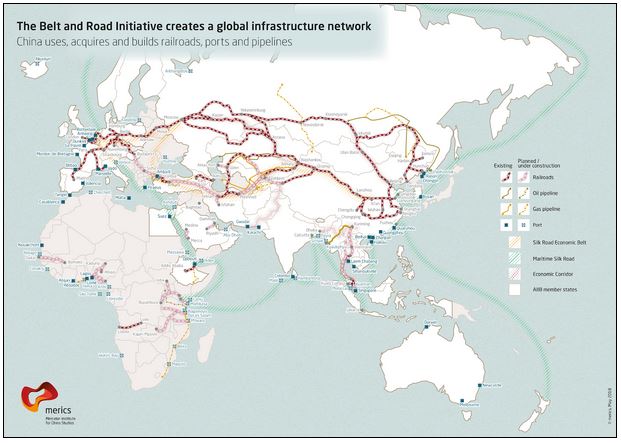
Whether in the constitution and expansion of maritime, terrestrial or digital flows, “the BRI focuses on building greater capabilities through infrastructure and prioritizes key sectors such as transport, communications and energy” (ibidem), having infrastructure as a key element that improves “connectivity and promotes trade and investment through the countries participating in the BRI” (CHEN & LIN, 2018, p. 2), seeking to establish and develop some land corridors (the belts) and maritime routes (the maritime silk road and the polar silk road). The map below, prepared by MERICS (Mercator Institute for China Studies), illustrates some of these corridors and routes connecting Asia, Europe and Africa by land and sea:
Mapa. A Iniciativa do Cinturão e Rota cria uma rede de infraestrutura global
Some key BRI moments are listed below:
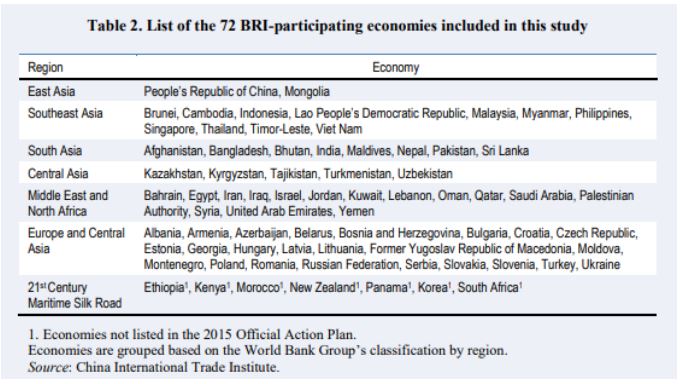
Conceived as a portfolio of projects around the world that have in common the objectives of expanding connectivity, trade and investment flows, the BRI has been mainly associated with projects located in the Asian, African and European continents, as seen in most part of the sources about the Initiative. Latin America, as a region that has several countries with significant trade and investment relationships with China, appears more recently in the BRI’s specific investment documentation. The following table, taken from the 2018 document of the OECD China’s Belt and Road Initiative in the Global Trade, Investment and Finance Landscape, presents a list of BRI participating countries in which only Panama is included, from the American continent:
>
However, in the course of the period starting in 2013, the BRI has expanded its intentions and project plans towards Latin America as well, especially since the first BRI forum held in May 2017 and some bilateral meetings, for example with Argentina, Chile and Panama. Note how the imprecision in defining which investments are part of the BRI makes it difficult to assess how the Initiative represents a turning point in the pattern of Chinese investments in the region, or a ‘before and after’ of the BRI from the point of view of Latin American region. From the recent perspective of Chinese financing banks (the Development Bank of China and the Export-Import Bank of China), for example, “Chinese bank loans in 2018 were directed, for the most part, to the same small subgroup from countries that have been receiving Chinese state funding for more than a decade” (MYERS; GALLAGHER, 2019, p. 1).
The expansion of the scope of the BRI towards Latin America, as a discourse or potential change in investment patterns, is related to the change in Chinese foreign policy of which the initiative is part, towards a more proactive role in its geostrategic interests, particularly in regions and countries neighboring China. An example of this posture is the China-Pakistan Economic Corridor, one of the symbols of the BRI, in which the port of Gwadar is projected as having significant logistical importance for the supply of energy to China, especially in terms of avoiding the Straits of Malacca, in Southeast Asia (CAI, 2017, p. 4). In the Latin American context, the rapprochement with countries under strong US influence, such as Panama, is a strong indication of the geopolitical role that the BRI has been playing worldwide, moving away from an initiative merely aimed at expanding markets or using idle domestic capacity, and more generally about the “explicit strategy of the Chinese government to encourage the internationalization of its companies, especially state-owned companies, since the early 2000s”, a movement that involves reasons ranging from “guaranteeing sources of raw materials” and access to markets and technologies to the intention of “raising political influence abroad”, in a scenario of slowdown in Chinese economic activity (HIRATUKA, 2018, p. 123).
Regarding the BRI, it is important to point out that the definition of which projects are or are not part of the initiative is not very precise, accentuating its element of geopolitical ‘marketing’ (as Ian Bremmer states, in a program where the BRI is discussed) and making it difficult the differentiation of projects that are effectively related to it. And if, on the one hand, such imprecision implies that a diffuse variety of investments made by Chinese entities can be presented as being part of the BRI, on the other hand, it can have negative effects on the initiative, associated with reputational risks, for example. In this sense, the Chinese government has been moving to better define which projects are actually part of the BRI.
In the Latin American context, it is important to place the BRI in relation to the Chinese investments that were already being made in the region and in Brazil in particular, as well as the trade and investment patterns of China-Latin America relations — highlighting the differences between such patterns for South America, in relation to Central America and the Caribbean (JAEGER, 2016) — and China-Brazil. From there, we think it will be possible to assess the potential geopolitical and economic effects of the BRI on the region and on Brazil and Bahia, and within this panel we will have other texts and productions dedicated to these themes.
In a more general/global sense, the main projects related to the BRI involve the construction, expansion and improvement of railways, ports, roads and electricity generation and distribution, in addition to investments in information and communication technologies. Despite claims that the BRI is a ‘win-win’ initiative and aligned with sustainable development principles, a substantial part of planned, ongoing and completed projects is still based on extractive paradigms and situated in delicate environmental, social and political contexts. We intend to develop some of these aspects in the following texts, outlining Western perspectives on the BRI, as well as analyses aimed at assessing whether the economic standard promoted by the BRI is aligned with the Sustainable Development Goals and a broader ‘win-win’ perspective (involving environmental and social issues of the various investment contexts), in addition to raising some issues related to the so-called Digital Silk Road.
What are the main elements that relate the BRI to the Latin American continent, and in particular to South America and Brazil? The idea of this topic and the others that follow is to understand how the relationship between China and Latin America is established and how the BRI is integrated into this context. Some general traits are present in this section. More detailed information is available in subsequent topics.
The debate about the BRI in Latin America is recent. Although the initiative was originally launched for Europe and Asia in 2013, it has since expanded to other regions. However, it was only after 2017 that the first cooperation agreement was signed under the BRI banner in Latin America. Panama was the first country to formalize relations with the initiative, a consequence of the country’s establishment of diplomatic relations with the Chinese.
However, according to Abdenur and Levaggi (2018), only a few Latin American countries have actually realized the strategic importance of the BRI and have made efforts to join the initiative. For most of these countries, the BRI has been mentioned occasionally in the media and has been little explored in discussions outside of politics and within universities. With this, the authors defend the importance of strengthening the debate on the proposal and its possible implications for the region so that a broader discussion on partnerships, markets and institutions can gain the necessary impetus.
After Panama, other Latin American countries spoke in favor of or signed agreements with the BRI proposal. However, there are still some challenges for China’s foreign policy with Latin America, given that its largest economies (Argentina, Mexico and Brazil) have not yet signed any partnership agreement with the initiative. The reason would be the US influence on Latin American countries, which discourages closer initiatives or closer cooperation with China.
However, although there is no formal BRI agreement between Brazil and Argentina, for example, other bilateral cooperation agreements are established between them and China, in such a way that the Chinese finance and articulate large investments in infrastructure in these countries.
According to Abdenur and Levaggi (2018), the BRI has as an important objective the improvement of physical and institutional connectivity between countries, in such a way that this initiative becomes something that goes beyond a Chinese foreign policy tactic or even pure commercial entrepreneurship. Following this line, despite recognizing the importance of different forms of cooperation (bilateral, regional, triangular or multilateral, regional), China makes a clear defense of free trade and takes a stand against protectionism, so present in North American economic actions.
According to the authors, the possibility of forming and consolidating a free trade area between Asia and Europe generates good perspectives for Latin American countries that have more open economic relations, such as Chile, Peru, Colombia and Mexico, and may even to have its effects propagated to closed economies or those that already have established investment and trade ties with European or Far Eastern countries. More specifically, these effects can occur indirectly, but no less significantly. Investments in infrastructure in European and Asian countries, through the BRI, can create prosperity for those countries not contemplated by the Chinese initiative, like some Latin American countries, but which are directly commercially related to the European and Asian countries involved in the project. Such investments in infrastructure have the potential to promote urbanization and the creation of new consumer markets within the countries contemplated by the initiative, consequently stimulating the importation of commodities and other products offered by commercially related countries. In other words, the BRI initiative has a good potential for repercussions in Latin America, even if most countries in that region are not formally linked to the project.
Currently, China is the main trading partner of several Latin American countries, such as Brazil, Chile and Peru. Furthermore, China has already become one of the top three trading partners for Latin America as a whole. The continent is also the fourth largest trading partner of the Chinese economy, a position that has been relevant in the definition of China’s foreign policy guidelines, in view of the broad supply of energy and food from its countries, important raw materials for the continuity of the Chinese development.
The authors also draw attention to the possibility of carrying out BRI investments in Europe and Asia to strengthen Latin American competitors within Eurasian markets or even markets in other areas. As an example, the authors highlight the importance of Brazilian construction companies that expanded significantly between 2000 and 2010, investing in several countries in Latin America and Africa during this period. For them, the effects of these initiatives go beyond the defined official limits and have the potential to reach several other places in the world (ABDENUR; LEVAGGI, 2018).
Given this context, the following are some reflections on the characteristics of Chinese investments in Latin America, highlighting the specificities of South American contexts, as well as on the recent dynamics of Chinese investments in Brazil, with more specific comments on possible strategies and consequences for the state of Bahia.
Brazil is the main destination for investments made by the Chinese in Latin America, being responsible for 55% of all value directed to Latin American countries, according to data prepared by the Atlantic Council, in partnership with the OECD Development Centre. Between 2007 and 2017, around 100 Chinese companies, through 157 projects, announced investments in Brazil – between intentions and confirmations – totaling US$ 98 billion. When considering only the confirmed projects, the value reaches US$ 55 billion, with 115 projects completed or in progress.
The entry of massive Chinese investments in Brazil reflects the reordering phase of a bilateral agenda that was established in the first decade of the 2000s. This process not only reflected in the expansion of investments, but also in the expansion of the trade volume between the countries.
It is important to emphasize that despite the prominence in Latin America, Brazil is not an isolated case. In the mid-2000s, the central government of China began a tactic to internationalize domestic companies, especially in considered strategic sectors by Beijing in several countries, which at different stages focused on natural resources, the consumer market and the induction of technological catch-up. .
IDP ranking from China was the 25th highest in 2016 by immediate investor country criterion. However, by the ultimate controlling country criterion, China’s position rises to 13th. This difference reveals that a considerable part of Chinese investment in Brazil is channeled through intermediary countries, and not invested immediately from China.
Since 2010, the focus of Chinese investments in Brazil shifted to industrial sectors, with the aim of exploring the Brazilian consumer market. Then, from 2013 onwards, a series of investments in the service sector began to gain space, especially in the financial area, with the entry of several Chinese banks in the country. Finally, the most recent phase, established in 2014, is especially focused on the energy and infrastructure sector, with massive investments by large Chinese companies that began to consolidate their presence on the Brazilian energy map.
In recent years, Latin America has grown its trade with China immensely. In this context, South America, in particular, is increasingly consolidating itself as a source of raw materials for China.
The balance of trade between the subcontinent and the country is in surplus and this fits like a glove with the Chinese strategic objectives, strengthening the ties of mutual dependence. On the one hand, South America needs China to overcome its structural balance of payments deficit problem. On the other hand, China needs South America to meet its growing need for raw materials.
China is currently experiencing a new process of economic slowdown. It is too early to diagnose and predict the problems caused by this, but when observing the capacity that China has been displaying in articulating its economic agents to a national project, in addition to the immense capacity for revising and correcting courses that the country has already demonstrated, it is not wise to believe on a catastrophic, or even pessimistic, outcome.
In the last two decades, China combined an export strategy with strong capital flow control and intervention in the exchange rate in order to keep it relatively undervalued (“artificially” improving competitiveness) and stable (reducing inflationary pressures). The strategy proved to be virtuous, as while it became a surplus in trade with the US, leading that country to an external deficit, China itself financed it, via the purchase of bonds in dollars, accumulating reserves. This funding, in turn, kept the dollar-yuan ratio stable, feeding back the cycle.
However, such a strategy seems to be on its way out. The vast majority of investments in the country’s internal infrastructure is made through earmarked credit, tax incentives and other forms of public debt. Debt costs have shown an upward trajectory and are starting to become heavy. At the same time, huge dollar reserves do not generate compensating returns.
China has never developed a large capital market or private financial system. China’s development finance is almost entirely public, sourced from its conglomerates or state-owned development banks. The search for higher rates of return has led to some movements in the Chinese economic development model (and consequently its international insertion). Gradually, the strategy of exporting goods is giving way, to some extent, to exporting capital, the two coexisting and complementing each other.
In the case of South America, the previously mentioned co-dependency in trade in natural resources also influences the nature of new Chinese investments in this new path of international insertion. To ensure access to South American raw materials, most Chinese investment has been in transport infrastructure, energy and support services for mining and agriculture.
Chinese demand for these products, notably oil, soy, meat, copper, aluminum and iron ore, tends to sustain its growth for a number of reasons. In the first place, even though the country has achieved many advances in terms of urbanization, there is still a lot of room to advance in this aspect, especially in the western provinces, with a less dynamic and predominantly rural economy. The Chinese urbanization rate was 54% in 2014 and is estimated to reach 70% in 2030 (World Bank statistics and estimates). The construction industry will demand a lot of metal to build urban infrastructure, especially the densest one (typical of large metropolises). Chinese food security policy ensures that cereal cultivation is more attractive than soybean cultivation, increasing the demand for imports from the latter. The income elasticity of meat consumption is high in China, leading to the belief that Chinese imports of meat and animal feed raw materials, such as soybeans and corn, should rise more than proportionally with the increase in Chinese income.
Even though, in absolute terms, the supply of Chinese mineral resources is significant – 13% of coal reserves, 8.5% of iron ore, 4% of copper ore, 2% of oil reserves in the world -, its immense territory and population, especially in a context of accelerated industrial growth, generate a relative scarcity of them. Since the 1990s, China has shifted from being an exporter to an importer of oil.
Another relevant reason is the size of the Chinese heavy industry. We know that this is an industry that is intensive in natural resources. Since the Revolution, heavy industry has been crucial for China, seeking self-sufficiency or stable suppliers of this type of product. Even if there is a gradual reorientation towards domestic consumption and less polluting industries, the demand for products from this industry – and, with it, the demand for natural resources – will remain at high levels. In fact, China has reallocated this type of industry to partners in Asia and Africa, in its gradual process of import substitution. Even so, the displacement of production units does not influence the still strong demand in China.
For each of the three main natural resources traded by South America with China – oil, iron ore and soybeans – there is a Chinese strategy for exploiting resources, involving instruments such as foreign direct investment in infrastructure, loans, mergers, among others. In the following topics, the main characteristics of trade relations between the Chinese and South American countries for these main products will be presented.
According to data from the International Energy Agency, an increase in Chinese demand for oil of almost five million barrels per day is estimated between 2014 and 2040, mainly caused by a vertiginous growth in its vehicle fleet. At the same time, it is also estimated that, even considering the use of improved oil recovery techniques and the development of tight oil production, Chinese production will decline in the coming decades, as its main oil fields are mature, with their production on a decline.
In this context, among China’s main sources of supply, namely: Commonwealth of Independent States (CIS), Middle East, Africa and Latin America, the latter was the one that grew the most between 2003 and 2015 (42% per year). In 2015 they accounted for 13% of imports and 8% of Chinese oil consumption. In this sense, such information already indicates the essentiality of the Latin American offer for the supply of an important good for the continuity of the Chinese development process.
Within this market, in general, China seeks to establish permanent trade ties through diplomacy. As part of its autonomous development strategy, the country has been resorting to two main instruments to guarantee the supply of oil: direct investment via public companies and loans via public banks, paid in oil by the suppliers of the raw material.
As for Latin America, the establishment of these ties has been done preferably through the acquisition of rights over the fields of already established companies or by acquiring part of the companies that have such rights. In addition, Chinese companies have recently started to invest in more audacious projects from a technological point of view, including deep water projects in the Brazilian pre-salt fields.
It is important to emphasize that China does not consume most of the oil it buys from Latin America via direct investment and loans paid for in oil. Especially South American oil, which is heavy and unsuitable for Chinese refineries. Part of the acquired volume is resold. For China, even the acquisition of lighter Latin American oil would be of little advantage due to the logistical costs involved, considering that the acquisition of this product can also be carried out through other sources at a lower cost, such as the Middle East.
So, it becomes clear that China’s priority regarding South American oil is to guarantee ownership of the product and send it directly to the country if necessary. China plans to build a refinery on its own territory to treat super heavy oil, typical of Venezuelan and South American fields in general.
Therefore, it becomes clear that Chinese investments in South American oil follow a logic of geopolitical and geoeconomic placement. Despite recent reforms in the country giving greater autonomy to state-owned oil companies, which can define their tactics and objectives for global acquisitions, this has not meant strategic autonomy, as the main goals are set by the government.
After Oceania, Latin America is the main source of iron ore imports from China. Chinese imports of the product from Latin America increased from 17 million tons in 2000 to almost 220 million tons in 2015, of which 192 are from Brazil, 11 from Chile and 5 from Peru.
It is important to point out that, before the 2008 crisis, the increase in Chinese imports of Latin American iron ore was also due to a strategy by the company Vale, which is currently responsible for 80% of China’s imports of iron ore from Latin America. With the crisis, Europe and Japan, Vale’s main buyers, drastically reduced their demands, forcing the company to redirect its exports to other markets, creating opportunities for links with China. In addition to Vale’s strategy, the Chinese insertion in the Latin American ore market has advanced a lot after the bilateral free trade agreements with Chile and Peru.
Regarding foreign direct investment, most Chinese mining companies that have arrived in South America are state-owned, although private and hybrid companies have also been established on the continent. These companies prefer to access resources through the majority acquisition of rights over mines from companies already established in the region or through stakes in companies that hold such rights.
In this context, the South American country that received the most Chinese projects in the mining sector, in the period 2006-2014, was Peru. This is mainly due to the existing commercial relationship (provided by the investment of the Shougang group in 1992 and strengthened by the 2010 bilateral agreement), its particularly liberal legislation in terms of foreign investment (including land purchases) and, of course, its great availability of natural resources.
In Argentina and Brazil, despite the presence of restrictive laws for the purchase of land by foreigners, Chinese investments in the sector have been strong, via the purchase of mine exploration rights or via partnerships with local companies for undertakings.
China’s access to South American soybeans, contrary to the news released by some media, is not being achieved significantly through direct investment in “land grabbing”. Far from it, to define its strategy, China was inspired by the large transnational companies that control the entire soybean production chain (except cultivation). The key to the strategy has been to acquire companies that already have a logistics infrastructure in the region for marketing soybeans.
In fact, only two investments made by Chinese capital companies with the aim of acquiring land to access Brazilian soy were confirmed. In 2007, the partnership between Zheidang Fudi Agriculture Group and the Department of Agriculture of Heilongjiang province purchased 16,800 hectares of Brazilian land (in RS and TO) for US$48.6 million. The second confirmed investment was from the Chongquing Grain Group (CGG) at the end of the 2000s, when the company acquired 52,000 hectares of land in western Bahia. Remembering that the law prohibiting the sale of Brazilian land to foreigners is from 2010.
Due to the processes of verticalization and horizontalization of production that have occurred in recent decades, the soybean market in South America has been controlled mainly by four large transnational trading companies, known as ABCD (Archer Daniels Midland or ADM, Bunge, Cargill and Luis Dreyfus). These companies control everything from financing, supply of inputs and technical assistance to commercialization of production (purchase of seeds, storage, processing, export and sales in the domestic market).
In Brazil, these companies provide financing to soy producers through the advance purchase of production. Thus, the mercantile company, which has its own logistical capacity, will decide how the grains will be marketed. This type of negotiation used by companies to acquire raw materials fosters a great dependence of producers on transnational trading companies, as a single player becomes a financing agent, a supplier of inputs, a technical assistance agency and a buyer of production.
In South America, even before the planting season, small producers – less capitalized – can commit about two thirds of their harvest through this type of financing. Even the most capitalized farmers frequently commit close to a quarter of their production.
ABCD trading companies have considerable oilseed processing capacity in China. Thus, by controlling the marketing of soybeans in South America, they use their logistical capacity to market and export soybeans to their own processing units in Chinese territory.
Additionally, restrictions on the purchase of land by foreigners ended up reinforcing China’s “natural” tendency towards a strategy of controlling soybean logistics and infrastructure. Even so, they do not prioritize “greenfield” investment, whose nature is riskier and with slower return, in addition to meaning bureaucratic confrontations. Chinese agro-industrial capital has acquired non-local companies operating in South America. For example, China National Cereal, Oils and Foodstuffs (COFCO) bought 51% of Nidera and Noble Agri in 2014. In 2015, it acquired the remaining 51% of Noble Agri.
COFCO’s intention in acquiring these companies is not to operate as a producer per se, but as a trading company, operating in a logic that is similar to that of the ABCD.
China intends on major investments of the greenfield type in Latin American territory, totally new – in Brazil they show interest in Ferrogrão, for example – however, they prioritize the acquisition of companies that already have a local presence, in addition to a logistics network ready or in need adjustments and improvements.
The new expansion dynamics of Chinese investments has generated significant repercussions in Brazil, in view of the increase in the volume of investments in the country within the Brazilian economy in recent years. Between 2007 and 2017, “about 100 Chinese companies, through 157 projects, announced investments in Brazil – between intentions and confirmations – totaling US$ 98 billion.” (CONSELHO EMPRESARIAL BRASIL-CHINA, 2018, p. 6). Added to this, over the last few years China has become Brazil’s main trading partner, being the largest destination for Brazilian exports.
Chinese investments in Brazil in 2017 surpassed those of 2016 in values. This performance reflects a growth dynamic since 2014. From 2016 to 2017 the number of investments jumped from 16 to 35, according to data from the Brazil-China Business Council (2018). It is believed that this growing range of investments is the result of a trend of internationalization of their domestic companies, mainly those related to activities intensive in natural resources. In this sense, its investments in Brazil refer to a much broader logic of extroversion of its companies to different areas of the world. Added to this, it is important to emphasize the geopolitical variable in this process. There is a definite geopolitical interest of China in occupying spaces, where Brazil is inserted as a strategic point in Latin America, so that this can explain the predominance of its investments in the Brazilian economy within the Latin American continent, as explained above.
According to a study prepared by the Atlantic Council, in partnership with the OECD Development Center, between 2003 and 2016, 55% of Chinese investments in Latin America were directed to Brazil, which positions the country as the undisputed leader in terms of attractiveness for Chinese investments in the region. (BRASIL-CHINA BUSINESS COUNCIL, 2018, p. 8)
The profile of Chinese investments in Brazil has changed over the years, not only in terms of quantity, but also in terms of quality. Until mid-2010, Chinese investments had a profile focused on the commodities sector, due to the growing demand for oil, soybeans, and ores. From this, a change in the profile towards the industry sectors was identified. Such a change would be linked to the Chinese objective of exploring the Brazilian consumer market. But, in 2013, a new change in investments signaled the country’s interest in investing in the services sector, especially financial services, due to the entry of Chinese banks in Brazil. Finally, in 2014, these investments are more focused on the energy and logistics infrastructure sectors, specifically in the railway and port ones (CONSELHO EMPRESARIAL BRASIL-CHINA, 2018).
It is also important to emphasize that a significant part of these investments has been made in the form of mergers and acquisitions. The advantage of these procedures is the greater profitability gained from operating in existing assets and consequently, already aligned with Brazil’s bureaucracy. In addition, the importance of the Chinese state in the process of carrying out investments in Brazil is highlighted.
In terms of value, Chinese investments in Brazil in 2017 were mostly allocated to the electricity sector, with a 68% share of total investments. Among these investments, the acquisition carried out by the Chinese company SPIC Pacific Energy, via auction, of the São Simão Hydroelectric Power Plant, located on the Paranaíba River, on the border between Minas Gerais and Goiás, stands out. Office openings were also identified for the companies JA Solar and Trina Solar, operating in the electrical appliances sector, in addition to confirmation of increased investments by the company BYD in its electric bus and solar panel factories. The predominance of investments in this sector is related to the large amounts invested in each project.
The second sector of activity that stood out the most in 2017 was agriculture and livestock, representing 15% of the total amount invested. The acquisition of seed assets and the purchase of companies already established in the country such as Belagrícola (53.99% of assets) and Landco (49% of assets) are examples that stand out. In addition, Chinese investments in the pet market were also identified when they acquired a food and chewable products factory for animals, in Rio Grande do Sul.
The third sector that most received Chinese investments in Brazil in 2017 was storage and auxiliary transport activities (10% of the total investment value), with the main highlight being the purchase of 90% of the participation in the Container Terminal of Paranaguá by China Merchants for US$ 925 million.
In relation to the other sectors, their shares were of little relevance in terms of value. However, it is important to highlight that, in terms of quantity, the Oil and Natural Gas Extraction sector took the lead in investments made in 2017, despite only representing 1.8% of the total amount invested.
An important point to be highlighted is that most of the amount invested comes from Chinese state-owned companies, which represent 87% of the amount, while private companies were responsible for 13%. This is explained by the fact that Chinese state-owned companies are primarily responsible for large-scale investments in the logistics, energy and mining sectors. Private companies, on the other hand, have presented investment initiatives in office openings, technology, automobile production and home appliances.
Finally, it is important to emphasize that the Southeast was the region that most concentrated Chinese investments in 2017, representing 51% of the total. This is explained by its extensive transport and industrial infrastructure, in addition to being the largest consumer market in the country. Then, the Northeast and Midwest Regions equally acquired a 17% share, followed by the South (11%) and North (4%) Regions.
One of the great challenges of Bahia’s economy in the face of the current context of global economic crisis has been to seek to increase its economic growth through State initiatives, either directly making investments or articulating investors to carry out their businesses within their borders. Considering these difficulties, among alternatives, one of the strategies used by governments to move their economies has been to attract foreign direct investment. Foreign economies with an interest in investing in other countries have been seen as promising paths for the implementation of initiatives that bring development, in view of the drop in investments by companies internally.
In Bahia, encouraging investments in infrastructure has been considered a successful way to generate greater business dynamics, increasing the expectation of stimulating new productive investments in other sectors of the economy. Bearing in mind the need to improve transport infrastructure within the state, initiatives to attract external funding for projects aimed at reducing transport bottlenecks have been seen as positive actions to achieve projects that encourage the dynamics of Bahia’s economy, especially in the current context of low economic growth in Brazil.
Considering the recent performance and dynamics of Chinese investments in the country, we sought to reflect on how this situation can be articulated with the needs of Brazilian infrastructure, understanding the main interests of Chinese investors. With this, we sought to understand how this dynamic can be promising for the needs and interests of Bahia, in the sense of improving its logistics infrastructure and, consequently, being able to contribute to new project initiatives being carried out.
It is possible to identify a set of investments announced and even already made by China in Brazil that, when related to the Brazilian economic dynamics, create some hypotheses about possible Chinese action strategies in the country, seeking to understand how these investments interfere and link their savings.
The construction of these hypotheses takes into account not only the planned investments of Chinese origin in Brazil and South America, but also other projects planned for Brazil in the infrastructure sector that could enhance economic performance and logistical integration among Brazil and the other countries in South America. The more integrated, the more advantageous for China to invest in the region.
The construction of these hypotheses arises from the search to understand how Brazil and Bahia are integrated or articulated to the new context of expansion of Chinese investments around the world, including the BRI initiative. In light of this, we have some observations.
It is important to highlight that the BRI, despite its expressive magnitude and connection with several countries, seems to have a priority reach in carrying out investments in Asia, Europe, and Africa. In this sense, it is not possible to identify in a clear and defined way a solid set of investments for South America that represents an arm of this initiative in the continent. However, that does not mean that there are no other investments. A list of investments was previously presented, mainly in Brazil, showing that there is Chinese interest in investing in Latin American countries. And although there is no direct consonance with the BRI, it is possible to identify patterns in investments, in addition to establishing some hypotheses of possible specific strategies. This perception is important to situate the positions of Brazil and Bahia in this new context and, at the same time, identify the real possibilities of these spaces to establish business relations with China through the direct investments that it makes in various parts of the world, in view of their more peripheral positions regarding direct participation in the BRI project. So let’s see what those hypotheses would be.
The first hypothesis to be raised about China’s possibilities for action and strategy in Brazil is related to a new set of investments in infrastructure, interconnecting a region in the south of Brazil with Chile and establishing a rail branch linking the South American coastal regions, both on the Pacific and Atlantic sides. The investments are:
The union of these two investments opens a broad business zone between Brazil and China. Such projects are essential to guarantee the Chinese closer access to one of the main production areas of soybeans agribusiness in Brazil, located in the states of Mato Grosso do Sul, Paraná, Rio Grande do Sul and Mato Grosso, being able to outflow such products through a railway line and its own port. In addition, these two investments make it possible for two alternatives for the outflow of commodities to consolidate: the first corresponds to exports through the Port of Paranaguá, arriving in China via the Atlantic Ocean, while the second corresponds to outflows through the Port of Antofagasta, in Chile, reaching China across the Pacific Ocean. The port of Paranaguá, despite having, according to the PNL, the most expensive transport cost to outflow the production from the Midwest, is responsible for exporting just over 20% of the national production of soybeans and derivatives.
It is also possible to identify, through the investment catalog published by the Initiative for the Integration of Regional Infrastructure in South America (IIRSA), several infrastructure projects that propose to interconnect the Port of Antofagasta with important areas in Brazil, Argentina, and Paraguay. Through these investments, it is possible to identify the formation of logistical corridors that would provide greater mobility of goods flows, which makes it even more attractive for Chinese investors to carry out their project, considering that the combination of these investments reinforces the logistical infrastructure that allows access to one of the most developed areas of Brazil.
The first major project cataloged by IIRSA consists of the construction of new sections of railroads and the recovery of others between countries in South America. The execution of these investments will allow the interconnection between the ports of Antofagasta (CHI) and Santos (BRA). The first project consisted of building a railroad linking the Port of Antofagasta to the city of Socompa (Chile’s border with Argentina). Arriving in that city, the construction interconnects with an existing railroad, allowing the trip to the city of Salta (ARG), which is connected to the cities of Rosario and Buenos Aires, in Argentina, also via railroad (which has investments planned of being restored). In addition to this interconnection, Salta also communicates with the city of Santa Cruz de La Sierra, in Bolivia, where there is a metric railway line that goes to the Port of Santos, passing through Corumbá, in the state of Mato Grosso (border of Brazil with Bolivia).
Linked to these investments, other recovery projects for the Paraguay and Paraná rivers can be seen as a new element that strengthens the logistical integration between the South/Southeast of Brazil, Argentina, Bolivia and Chile. Dredging works are planned in stretches of the Paraguay River, starting from Corumbá (Mato Grosso – BRA) to Isla de Cerrito (ARG), where it meets the Paraná River, continuing with the recovery works throughout its route to Buenos Aires. These investments have the capacity to further enhance regional logistics, considering that the Paraná River passes through major Argentine ports, such as Buenos Aires and Rosário, which are also interconnected by the railways presented above. Likewise, this access allows a waterway trip to Corumbá, where there is also a railway branch linking to the Ports of Santos and Antofagasta. Other projects to recover railroad branches in Argentina are also helping to strengthen logistics in that region.
In addition to these advantages, the Chinese control over these investments makes it easier for manufactured and technology-intensive products from China to access Brazilian markets, especially those in the South and Southeast, areas that concentrate most of the country’s consumer market.
Mapa esquemático dos investimentos que compõem a hipótese 1
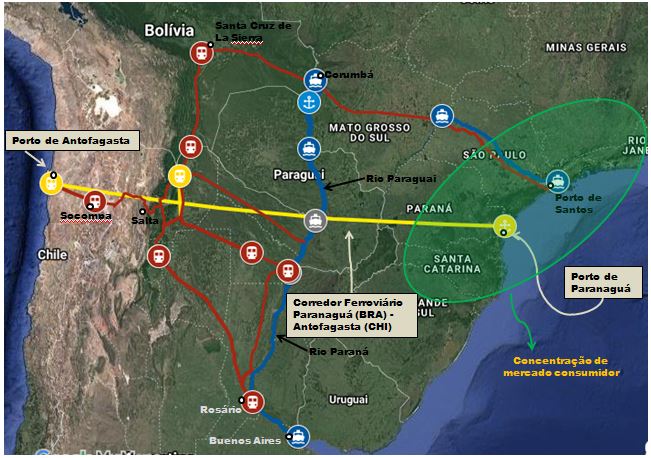
Fonte: Elaboração própria
The second hypothesis raised is related to the possible investments identified in the railroad area that connects the Brazilian coast to the railway network of Peru, passing through the cities of Campinorte (GO), Lucas do Rio Verde (MT), Vilhena (RO), Porto Velho (RO), Rio Branco (AC) and Boqueirão da Esperança, in Peru. Named Transcontinental Railroad or Bioceânica Railroad, this project has a physical extension of 4,400 km and is of great relevance to Chinese business, given that it is an important alternative to the Panama Canal route, the main route for ships to pass through seeking to reach Asia through the Pacific Ocean, currently influenced by the political directives of the United States.
This project already has a feasibility study completed since 2016, with the Chinese government as the largest investor. This railroad will allow easier access to beef and soybeans produced in Mato Grosso, Goiás, Rondônia and Acre, also lowering the costs of transporting ores.
In early 2019, representatives of the governments of Rondônia, Acre and Mato Grosso were gathered, along with a Chinese delegation of businessmen, led by the Chinese ambassador to Brazil, Ji Jinzhang. At this meeting, a protocol of intentions was signed by the governors of the three states and by the Chinese ambassador, aiming to formalize the interest in the international economic partnership between Brazil and China. There is even a joint declaration signed in 2018 among these two countries and Peru.
It is important to highlight that the final layout of the railroad in Brazil does not appear to be defined and two alternatives have already been presented and widely disseminated. The first consists of completing the railroad on the north coast of Rio de Janeiro, while the second consists of completing it in Santos (SP). In any case, both this second hypothesis and the previous one are characterized by not contemplating the Northeast region, that is, none of these projects pass through or are articulated with the infrastructure of the Northeastern states. In this sense, the effects of the possible execution of these investments would be little representative or even non-existent for Bahia. Such investments would reinforce a historical competitive advantage of the South and Southeast regions of the country, diminishing even more the possibilities of a better development of the states of the other regions. In this sense, Bahia would be largely harmed.
Mapa esquemático dos investimentos que compõem a hipótese 2
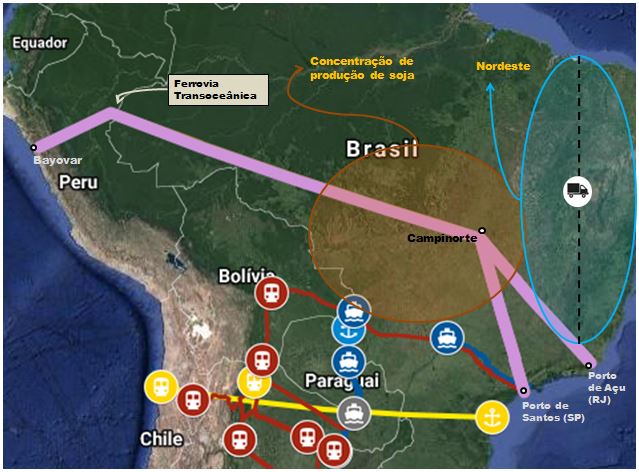
Fonte: Elaboração própria
The third major investment possibility identified for a possible Chinese action in Brazil corresponds to a derivation of the previous hypothesis, where the railroad would end its route following from Campinorte to the Port of Aratu (BA). This investment could be integrated with another large project already planned to be carried out in Bahia near this port. In summary, the initiative corresponds to a development project that will bring together the construction of a large integrated industrial park, comprising a steel plant, a power plant, and several cement manufacturing units. In addition to this, a project to revitalize the Port of Aratu and another to build a smart city near the industrial park aimed at housing the workers of this complex also make up this great initiative. In an interview, the governor of the state of Bahia, Rui Costa, stated that the project will cost US$7 billion and will have the capacity to generate 30,000 jobs. This would be the hypothesis with the greatest potential benefits for the development of economy in Bahia, considering that the projects that compose it are largely integrated with the state’s economic and infrastructure dynamics.
Mapa esquemático dos investimentos que compõem a hipótese 3
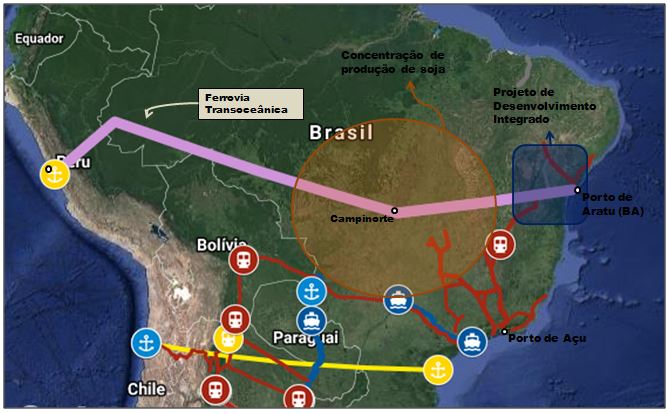
Fonte: Elaboração própria