Transport Logistics Project

The globalized economy is demanding more and more investments in transport logistics, which include all associated services and equipment, to allow for integration between production and consumption areas. As a result, regions and countries that have quality means of communication gain greater strategic importance, through high-capacity transport and the speed of interaction between people and companies with broadband Internet access systems. Linked to this, support services for the logistics of production and circulation of goods are developed with greater intensity, which are associated with other social services and personal services.
But it is necessary to plan to avoid regional concentrations. There is a tendency for some of these services to be concentrated in the world’s major metropolitan centers, especially those offering the highest salaries, employing a relatively smaller number of people, but requiring greater qualifications; Jobs created by the need for support services for this large circulation of people and goods on a world scale tend to be decentralized, but concentrated in the vicinity of major transport axes and urban and metropolitan support agglomerations, but with the same requirements of highly qualified workforce.
The regions of South America, Brazil and Bahia are placing themselves on the world market as suppliers of food and mineral inputs, whose characteristic of production with low added value requires important means of outflow to other regions of the world. In addition, competitiveness in this type of market requires continuous reduction of logistics costs since freight costs are proportionally higher for products with lower added value. The expansion of means of outflow and the reduction of freight costs should occur through new and large multimodal transport projects, which may have the capacity to create a new development cycle, changing the role and characteristics of some regions, notably in the case of Bahia, inserting them in world flows of circulation of capital, goods, and people.
Such repercussions could be enhanced in association with other public and private investments, depending on each Macro-region of the state, generating new jobs and demanding elements of local infrastructure, which could change the conformation, roles, and size of city networks, making them very different from the current reality, with much greater emphasis than isolated investments. With such magnitudes, some of these investments have the capacity to affect several Brazilian states and several macro-regions of Bahia, recommending an analysis of their set, at least, for the entire state of Bahia, so that their main repercussions for each Macro-region can be understood.
In this way, the ability to define public and private policies to enhance this investment network is gaining increasing importance, but also focusing on the formulation of public policies capable of creating mechanisms for the inclusion of marginalized families, offering the best public services that can improve their quality of life and increase their ability to adapt to the demands of new jobs. It is also important to create the infrastructure conditions to integrate regions in this new development process, in a competitive way and to build communities that have a balance between human activities, the natural environment and the built environment.
Ports now have a perspective of a strategic logistic node for the development of global trade flows. Bahia has a strategic location on the Brazilian coast and the South American continent to become a Brazilian logistics gateway, capable of increasing Brazil’s economic integration with other regions of the world. This may favor exports of agricultural and mineral commodities that develop on a large scale in the interior of South American countries and Brazil, in particular, to Asian, European and North American countries. On the other hand, Bahia’s ports can also assume a relevant role in imports of industrialized products, if investments are implemented in railways and highways capable of linking Brazil and Bahia with producing areas in other regions of the world.
If we analyze the national and South American physical integration projects carried out since the 1990s, with the Integration and Development Axes, undergoing some modifications over the last few years, such as PAC, PMI, etc., we can see that the latest governments of Brazil have a project structured by a vision of multimodal transport integration, aiming to overcome the model predominantly supported by the road system. To support the growing production of commodities that occupy areas with a low supply of infrastructure, the projects adapt to the new realities based on a design that tends to reinforce the articulation between the production areas and the ports, on the one hand, towards the states of the South/Southeast and, on the other hand, seeking to reinforce new investments in the new ports in the North of the country.
This system is based on a railway backbone, called North South, which connects ports from the North to the South of the country, allowing East-West connections that allow the integration of the production areas with the ports on the Atlantic coast. At the same time, the South American Integration Initiative project, IIRSA, is inspired by the Brazilian design, creating integration axes in the West-East direction, taking advantage of all Brazilian lines and articulating the ports of the Atlantic and the Pacific, allowing integration of different regions of South America with the production of the countries. (Cartogram 1).
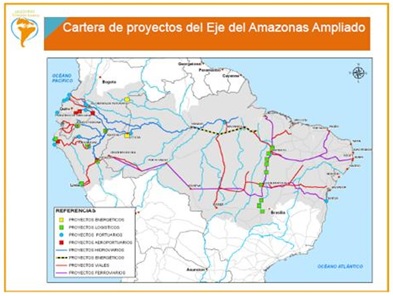
Fonte: IIRSA, 2012 Recent studies carried out by SEI show that Bahia may have the possibility of attracting investments with the objective of creating an East-West integration axis, through FIOL, with the perspective of integrating part of the production of the MidWest of Brazil with the ports of Bahia, transforming this state into one of the Brazilian logistics portals. When analyzing FIOL’s route alternatives, the studies concluded that the route with the greatest prospects of successfully competing in the dispute for cargoes in part of the Brazilian Midwest would be the one that would articulate with FICO, in the surroundings of Campinorte (Cartogram 2).

Fonte: SEI, 2015 In summary, if FIOL only reaches Barreiras, it is estimated that there may be a possibility of attracting cargo to the ports of Bahia in 2025 in the range of 3 million tons. If FIOL reaches Figueirópolis via Barreiras, it is expected to attract around 4.7 million tons in 2025. In the best alternative, if FIOL articulates directly with FICO, the possibilities reach around 10.1 million tons of grains.
For the purpose of analysis with a purely prospective character, we can work with analyzes on two extreme scenarios, which allows for an infinity of intermediate alternatives for investments in multimodal transport structuring routes and their results in the territory of Bahia.
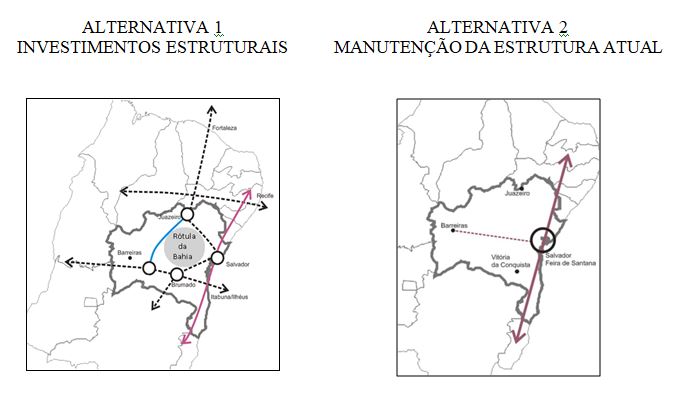
Alternative 1, designed for 2030, comprises a hypothetical situation, the best of the options, considering the resumption of growth, with overcoming the crisis, the increase in the production of agricultural and mineral commodities, the reduction of the deindustrialization process and a development with strong investments. In this case, Bahia would expand its integration with other countries, as well as with the production of grains and ores in the states of the Brazilian Midwest, through high-capacity transport routes operating in a multimodal network. As a repercussion, it would generate income with the presence of knowledge-intensive logistics services, which in turn would result in the creation of new job openings in personal services, business support services and the provision of public services.
However, this would not occur in the entire territorial space of Bahia, but in large concentrations of activities around the new logistical nodes, located at intersections of transport modes. In the cartogram presented above, one can see these concentrations capable of attracting migrants with different levels, from the highest levels of education and income, due to the characteristics of the jobs offered, to the lowest income levels, attracted by informal employment. These concentrations would be located near the cities of Juazeiro, Barreiras/Luis Eduardo Magalhães, Ibotirama/Bom Jesus da Lapa/Correntina, Caetité-Guanambi, Tanhaçú/Brumado, Jequié, Ilhéus/Itabuna and in the Salvador Macroregion. Such concentrations of people would demand new and intense investments in urban/regional infrastructure, with a strong presence of secondary integration routes, medium and small logistics platforms, highly efficient data flow offer and qualified urban equipment and public services.
In this way, the population in Bahia would have a tendency towards spatial decentralization with urban concentration of the population of Bahia. The largest share of these migrants should come from small towns in the interior of the regions that should attract investment, mainly people with less education and who should occupy low-paid jobs, although in greater numbers. But these cities will also be able to attract professionals from the largest urban centers and even from Salvador and other Brazilian capitals, although in smaller numbers, to perform more qualified and higher-paying jobs. And there may be a public policy for professional training and quality improvement in primary and secondary education. In this sense, there may be a reversal of migration, previously carried out from the Semi-Arid region to the Coast, to now also take place from the Coast to cities and regions of the Semi-Arid interior, which should create a better spatial distribution of the population in the territory of Bahia.
The investments planned and boosted by the grouping of these logistical nodes can create a great opportunity for Bahia to develop channels of articulation with all and between all neighboring regions and, mainly, can constitute channels of circulation between the areas with the greatest grain production capacity in Brazil with other regions of the world. If we consider the projects of the São Francisco Waterway and the requalification of the FCA railways, in their branches from Salvador to Minas Gerais and Salvador to Juazeiro, and we add the projects of logistic platforms in the Macro-region of Salvador-Feira de Santana, in Juazeiro, in Itabuna and Vitória da Conquista, we can understand that a large articulation of economic flows is being built.
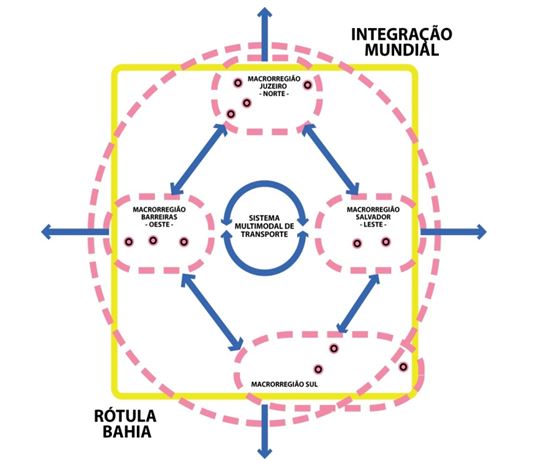
This system, which we call the Rótula da Bahia, may have the capacity to change the production and circulation of goods and people in the State, reorganize a large part of the network of cities, and, fundamentally, create new areas of production, based on modern services and industrial production units in certain regions of the interior of Bahia, with emphasis on the semi-arid region. Such alterations could lead to a new profile of the Bahia’s economy, shifting from its industrial transformation base to sharing this role with modern services to support the logistics of distribution of goods. The creation of a new and structuring network of modern intermodal infrastructure will be required, totally different from the existing network, and which will also require a new formulation of complementary projects, of a secondary nature, to radiate the process of circulation of the economy in the different regions of Bahia.
Bahia, which only had a road network linking the South-Southeast and Northeast of Brazil, in the North-South direction, which fulfilled its functions in a precarious way and still complying with a logic that was formed since the industrialization of Brazil in 1930s, therefore more than 80 years ago, now will be articulated in all directions and with all modes of transport. An overcoming of communications almost entirely concentrated in the north-south direction from the southeast, by a new diversification that registers the importance of east-west communication. This trend is the result of the new phase of insertion in the globalized economy in recent decades. Apart from the West region and RMS (Salvador Metropolitan region), all the others affected by the logistics nodes will be required to completely restructure their functions, their sizes and their qualifications for infrastructure elements.
The magnitude of spatial transformations requires important government actions, mainly to anticipate problems and boost investments, through the creation of specific programs of regional development policies, combined with specific policies for each of the municipalities involved. Alternative 2 can be characterized by the negation of all the conditions highlighted in the previous alternative and can be considered as a pessimistic scenario, a situation where GDP growth remains at levels below 2%. With the prospect of not overcoming the crisis, possible investments in infrastructure will be selective, remaining concentrated in the South-Southeast and a port in the North that may gain national and international competitiveness.
In this way, the Northeast of Brazil and Bahia could be excluded from investments, and the creation or consolidation of state transport corridors could occur, without allowing the integration of Bahia with other Brazilian states or other countries. In this way, the productive activities in Bahia would continue to have their integration via road with the South-Southeast and very likely the budget revenues will be relatively reduced, as well as there could be a deterioration of the installed infrastructure. In this situation, the productive activities related to agribusiness, installed in the far south (cellulose and paper), west (grains) and north (fruits), may have their production flow through high-capacity routes and ports located in neighboring states, as is predominantly done today.
In the Infrastructure for Development Program and in the Urban Development Program, with PGP proposals for the 2016-2019 PPA, there are a series of projects that show a strong relationship with the alternatives analyzed above. One of the strategic objectives of the Integrated Development Plan – PDI, which will guide the 2020-2013 PPA, is “to promote the expansion and integration of the public transport network, articulating the various modes and interconnecting the various regions of Bahia, with emphasis on transport over rails and air transport”. In the list presented by the PGP, the following projects stand out: – West-East Integration Railroad; – Implementation of Porto Sul; – Expansion of the capacity of the Port of Aratú for the export of agricultural products; – Construction and qualification of airports (Bom Jesus da Lapa, Senhor do Bonfim, Feira de Santana, Barreiras, Teixeira de Freitas and Ilhéus). Although these proposals are restricted to listing projects, without showing an understanding of circulation flows through the infrastructure network (spatial articulations and hierarchies of ports, airports, highways, railways, waterways, etc.), it is necessary for us to make an effort to understand some of these passages are not made explicit and are associated with other large infrastructure projects. The Federal government has three integration railways among its concession priorities: the North-South Railway; Transnordestina and the West-East Integration Railroad. The West-East Integration Railroad (FIOL) “is an economical, effective and safe transport alternative, with little environmental impact, capable of meeting the needs of the iron ore producing regions of Caetité and Tanhaçu, in the south of the State of Bahia , and grain producers in Western Bahia and Southeast Tocantins. When completed, the project will be 1,527 kilometers long” (map below).
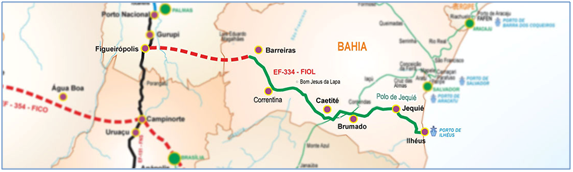
Among the benefits of this project is “Connecting the states of Tocantins, Maranhão, Goiás and Bahia to the ports of Ilhéus/BA and Itaqui/MA, which will provide better economic performance for the entire rail network”. This means that FIOL will be able to direct cargo directly to the Port of Ilhéus in Bahia and/or allow cargo to flow from Bahia through the Port of Itaqui, through the North-South Railroad.
This route through Figueirópolis offers alternatives for the flow of cargo from the West both through Maranhão and Bahia, but, on the other hand, it does not create conditions to attract cargo from Mato Grosso to Bahia’s ports, as we commented earlier in studies carried out by SEI to the FIOL layouts. However, according to news released by the Brazilian press in the first months of 2019, the Federal Government must prioritize the concession of three railways, and the concession of the North-South Railway has already been granted, and it is expected to promote the two other concessions to 2019 or early 2020, where the “West-East Integration Railway is located, which should connect Caetité to the Port of Ilhéus, in Bahia”[1].
If we analyze the projects announced by the federal and state government plans to be executed in the short term, we can conclude that they do not differ from Alternative 1 (creation of the Rótula da Bahia), but neither do they link Bahia with other regions of Brazil nor create a new logistic node.
The Macroregion of Salvador is formed by the conurbation of social and economic activities, interconnected by a dense network of infrastructure. It includes the Metropolitan Region of Salvador, the city of Feira de Santana and its aggregated urban areas, part of the cities of the old Recôncavo, the urban center of Alagoinhas and small districts located in its interstices. The potential of this Macro-region to become a major logistics hub was gradually built up by the aggregation of industrial investments in the vicinity of Salvador and Feira de Santana, assuming distinct but complementary functions, behaving together as a kind of large metropolis.
Salvador and its immediate surroundings have the port complex in Bahia de Todos os Santos, concentrate the activities of the state public administration, are home to most of the large companies in Bahia, comprise almost 30% of the state population and are responsible for approximately 70% of revenue of ICMS (Tax for the Circulation of Goods and Service). Feira de Santana, in turn, serves as a road logistics node through which most of the flows of goods circulate between the South-Southeast and Northeast of the country, as well as the distribution and reception of trade flows between the metropolis and other regions of Bahia and interior of Brazil.
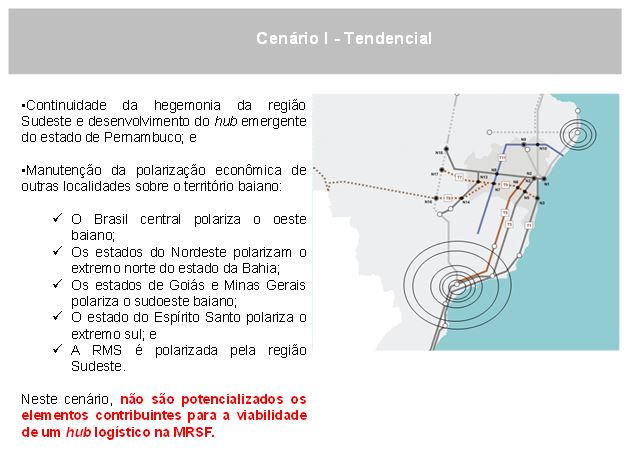
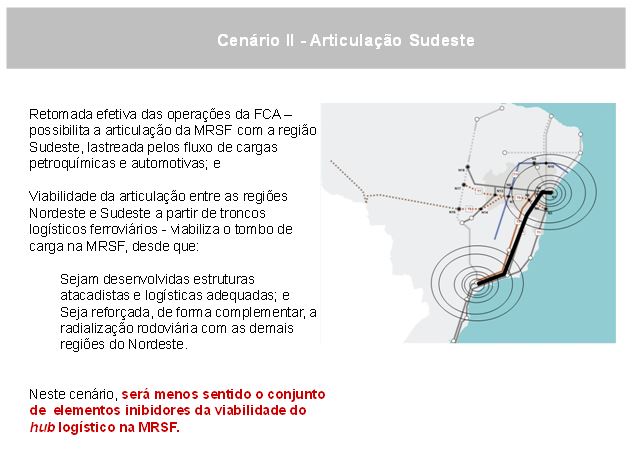
Studies developed by SEI concluded that the possibilities of transforming this Macro-region into a Logistic Pole would depend on investments in roads with high traffic capacity, articulating the production and consumption areas of the South-Southeast and Northeast regions of Brazil and between the Macro-region and the production areas of the Brazilian Midwest. The studies consider three distinct but complementary articulation scenarios, as shown in the following figures:

The main recommendations for the Macro-region Logistic Node to be set up would be:
The viability of the Rótula da Bahia, previously commented, basically depends on the reinforcement of the Logistic Node of the Macroregion, as an “engine” that would stimulate the circulation of goods and capital, increasingly promoting the flow of trade between this region and other regions of the world. This viability is associated with the concreteness of Scenario III and it will be this scenario that can reach Alternative 1, previously mentioned. Therefore, Scenarios I and II are associated with Alternative 2, that is, the one that can expand flows from Bahia to other states in the Northeast and South-Southeast of Brazil, maintaining the logic of economic exchanges that have been taking place for many decades.
The Brazilian development process took place with significant coastal occupation, but with a great density of economic activities strongly based on industry and support services, on investments in infrastructure and with a large concentration of people in the South-Southeast regions. In the Northeast Region, this occurred in a concentrated manner in the metropolitan regions of its largest cities, dispersedly located in the Northeastern territory.
It was not different in Bahia: the GDP was concentrated around the metropolis and in around the 30 largest cities articulated by a road network, mostly federal, which assume the role of regional poles of services and commerce, with some cases of investments in isolated industries. In the last 30 years, an agro-industrial production process has been developed in the extremes of the territory of Bahia, located in the west, north and far south. A large territoriality located in the center of Bahia, presents itself with a low density of investments in economic activities, as well as a low population density and reduced investments in infrastructure, apart in some cases located in a dispersed way.
This resulted in a state with a relatively high cost of investment in public services and transport, due to the great distances traveled in spaces with a spatial density of insignificant GDPs. Half of the cargoes are concentrated on three federal highways, BR 116, 101 and 322, which are experiencing major bottlenecks and play the role of linking Bahia with other states of the federation, notably in the north-south flows. The rest of the road system has low utilization rates. We still do not have rail and waterway networks with high cargo capacity, leaving only the practically abandoned branches of the FCA concession. Finally, the regions with the highest density of commercial flows in Bahia continue to be exclusively aimed at the Southeast/South and Northeast, while the Midwest and North regions are those with the greatest power to generate cargo flows.
In this direction, large investments are needed, as is the case of FIOL, to capture flows from the Brazilian Midwest. There are signs that may indicate uncertainties, which we cannot let happen. Bahia will be able to continue to relate exclusively to the Center-South, using the Highway System. The highest growth rate of the national GDP is in agribusiness, part of which is located in the extremes of Bahia and whose production may be exported through the ports of neighboring states, if some investments are made, as is the case of railway branches linking the West of Bahia with the ports in the North, using the North/South railway;
It is necessary to pay attention to trends in Bahia and the entire Northeast being marginalized in Brazil’s integration process with other countries. The creation of a Consortium for states in the South-Southeast was recently announced, where one of the priority themes is the implementation of systems with high integration capacity in transport logistics, which would probably lead to a greater concentration of exports through ports in these regions of Brazil. The results of this could be identified in several scenarios, but in all of them the large signs of poverty in Bahia and the Northeast could be expanded, part of the infrastructure could deteriorate, as the waterways and highways with low traffic flows of goods and people, and there may even be new and strong political processes of territorial disaggregation.
Analyzing the national political environment, we can deduce that from the campaign phase of the last elections to the first actions taken in the area of transport logistics, the Federal Government’s priority investments are only those with economic viability. In a recent seminar organized by CODEBA which addressed investments in ports in Bahia, representatives of the Ministry of Transport were emphatic in stating that the Government awaits contributions from the private sector for the presentation of feasibility studies for investments in the area of transport to prepare concessions . At no time was reference made to the induction of regional development.
There has been no talk of prioritizing investments to compensate for unbalanced development in the different regions of Brazil. Much less of regionalized policies. This is explicit, because in fact reinforcing investments solely through the market presupposes following trends. And the trends in transport logistics issues are towards ports in the South-Southeast and the opening of a new flank for exports from a port in the North of the country. This seems to be a public policy of the Brazilian government: to have a passive role regarding private investments, not acting as their inducer or planner. This tends to reinforce the already established routes, concentrating the development of the sector.
However, the international scenario can bring a different desire, to meet the logic of investments based on global geopolitical strategies. Will it be? What do the Chinese think about the most suitable investments for their global strategy of creating the “New Silk Road”? Would there be any route in a world perspective that could be different from national policy interests and that could be convenient for interests for the Brazilian Northeast, especially for Bahia? Or, pragmatically, will Chinese investors fit into the Brazilian government’s investment concentration trends? Could there be a conflict of interests located in the ports of the South-Southeast that would make new Asian investors unfeasible? These are some questions that can stimulate articulated discussions between the four panels made available to be elucidated in this SEICOlab Platform, about Transport Logistics.